


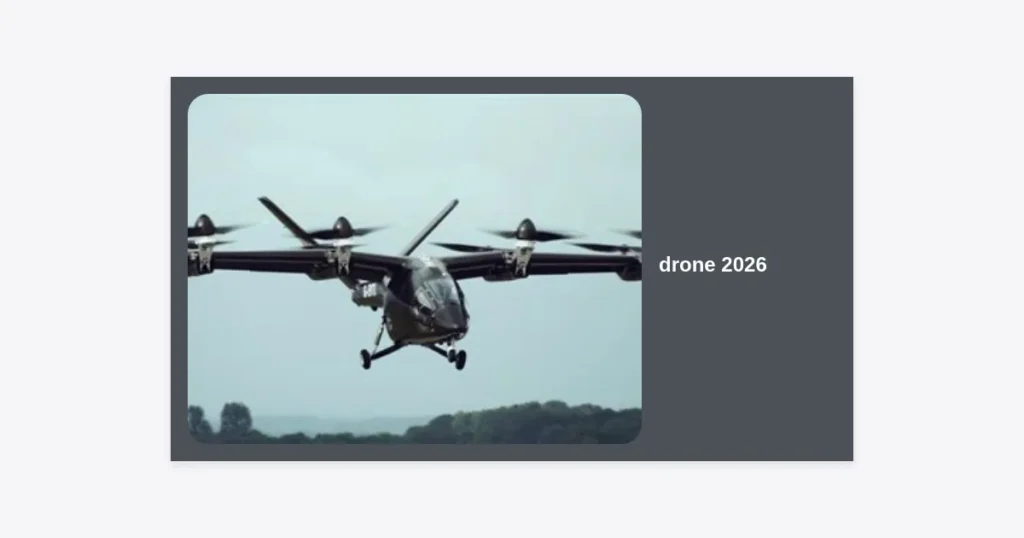

Are you ready for a sky that is more active, intelligent, and integrated than ever before? As we look toward the horizon of drone 2026, we are seeing the culmination of a decade’s worth of rapid innovation in aerospace, robotics, and connectivity. What was once a niche hobby for photographers or a specialized tool for the military has now evolved into a cornerstone of global infrastructure. In this comprehensive guide, we will explore how drone 2026 technology will reshape our cities, our economies, and our daily lives.
- The Evolution of Unmanned Aerial Vehicles
- Key Technological Innovations in 2026
- Commercial and Industrial Applications
- Consumer Drone Trends: What’s in Your Bag?
- The Regulatory Landscape: FAA and Beyond
- Challenges and Ethical Considerations
- How to Prepare for the 2026 Drone Revolution
- Final Thoughts: The Sky is No Longer the Limit
The Evolution of Unmanned Aerial Vehicles: Moving Toward Drone 2026
To understand the significance of drone 2026, one must look at the trajectory of the industry over the last five years. We have moved from simple remote-controlled quadcopters to sophisticated autonomous systems capable of processing vast amounts of data in real-time. By 2026, the distinction between a “drone” and a “flying computer” will effectively disappear.
The transition is driven by three main pillars: hardware durability, software intelligence, and regulatory acceptance. As we approach 2026, the market is no longer wondering if drones will be useful, but how quickly they can be integrated into existing workflows. Statistical forecasts suggest the global drone market will exceed $54 billion by 2026, representing a compound annual growth rate (CAGR) of over 15% from the early 2020s.
This growth isn’t just about selling more units. It’s about the expansion of Echo-systems. A drone 2026 unit is likely part of a larger fleet, managed by centralized AI and integrated into a city’s smart grid. This evolution marks the shift from “tools” to “infrastructure.”
Key Technological Innovations in 2026
The capabilities of a drone 2026 model are far beyond what we saw even two years ago. The convergence of several high-tech fields has created a “perfect storm” for UAV development.
Advanced Artificial Intelligence and Autonomy
In 2026, drones will no longer rely solely on GPS for navigation. Instead, they will use Visual SLAM (Simultaneous Localization and Mapping) coupled with onboard neural networks. This allows a drone to navigate through a dense forest or a complex indoor warehouse without any human intervention or satellite signal.
These AI systems are capable of predictive maintenance and real-time path optimization. If a drone detects a slight imbalance in a motor, it can adjust its flight path and return for service before a failure occurs. This “self-aware” tech is a hallmark of the drone 2026 era.
Energy Density and Propulsion Systems
One of the biggest hurdles for drones has always been battery life. By 2026, we are seeing the commercialization of solid-state batteries and improved hydrogen fuel cells for long-endurance missions. While a standard consumer drone might have flown for 30 minutes in 2022, a drone 2026 counterpart can easily push past the 60-minute mark, with industrial models staying airborne for several hours.
6G Connectivity and Edge Computing
While 5G laid the groundwork, the early whispers of 6G and the maturation of satellite internet (like Starlink) have given drones ubiquitous connectivity. This allows for “Edge Computing,” where the drone can process high-resolution 8K video in the air and only send back the relevant metadata, drastically reducing bandwidth costs and latency.
Commercial and Industrial Applications
The commercial sector is where the drone 2026 revolution is most visible. Business operations are being streamlined by the ability to put eyes (and sensors) anywhere in minutes.
- The Era of Drone Delivery: Last-mile logistics have been solved in many urban and suburban areas. Companies like Wing and Zipline have scaled their operations, making 15-minute delivery for medicine and small groceries a standard expectation rather than a pilot program.
- Precision Agriculture 2.0: In 2026, farmers use drone swarms to manage crops. These drones can identify specific plants that need more nitrogen or water and apply treatment only to those individual plants, reducing chemical waste by up to 40%.
- Public Safety and Disaster Response: Fire departments now use drones with thermal imaging to “see” through smoke and map the hottest parts of a building fire, allowing for safer entries and more efficient water placement.
“By 2026, the integration of drones into commercial workflows will be so seamless that we will stop calling them ‘special projects’ and simply refer to them as ‘standard operating procedure.'” — Dr. Elena Vance, Robotics Research Lead
Consumer Drone Trends: What’s in Your Bag?
For the average consumer, drone 2026 means devices that are smaller, quieter, and much more social. The “follow-me” technology has reached a point where it can navigate through crowds or under low-hanging branches with zero risk of collision.
Noise reduction has also been a major focus. The annoying “buzzing bee” sound of legacy drones has been replaced by low-frequency stealth props, making them much more socially acceptable in public parks and residential areas. Furthermore, the integration with Augmented Reality (AR) glasses allows pilots to see exactly what the drone sees in a fully immersive, heads-up display environment.
The Regulatory Landscape: FAA and Beyond
Regulation has finally caught up with technology in the drone 2026 roadmap. In the United States, the FAA has fully implemented Remote ID and established clear pathways for BVLOS (Beyond Visual Line of Sight) flight. This is the holy grail for drone operators, as it allows for long-distance missions without a human spotter standing in a field.
International standards have also harmonized. A drone certified in the EU now has a faster pathway to certification in North America and Asia. This regulatory clarity has unlocked billions in venture capital investment, as the “legal risk” of drone startups has significantly diminished.
Challenges and Ethical Considerations
Despite the progress, the drone 2026 environment faces significant challenges. Chief among them is privacy. As drones become quieter and more common, the conversation around “the right to a private sky” has intensified. Legislative bodies are debating how to prevent unauthorized surveillance while protecting the rights of commercial operators.
Cybersecurity is another major concern. A drone 2026 is essentially an IoT (Internet of Things) device with wings. The threat of “drone hijacking” or GPS spoofing is real, requiring manufacturers to implement military-grade encryption in all commercial-grade units.
How to Prepare for the 2026 Drone Revolution
If you are a business owner or a tech enthusiast, you shouldn’t wait until 2026 to start planning. Here is actionable advice to stay ahead:
- Get Certified Early: If you haven’t already, obtain your Part 107 (or local equivalent) license. The complexity of flight will increase, and having a foundational understanding is vital.
- Invest in Data Management: Drones are data-gathering machines. Start building the infrastructure to store, analyze, and act on the massive datasets that a drone 2026 will generate.
- Audit Your Workflow: Identify “dull, dirty, or dangerous” tasks in your current operations. These are the primary candidates for drone automation in the next 24 months.
Final Thoughts: The Sky is No Longer the Limit
The journey toward drone 2026 is not just about better gadgets; it’s about a fundamental shift in how we perceive distance and accessibility. We are moving toward a world where the vertical dimension is as busy and productive as our streets. From saving lives in search-and-rescue missions to delivering a hot cup of coffee in minutes, the impact of these machines is undeniable.
Key Takeaways:
- Autonomy is King: Drones in 2026 will navigate complex environments without GPS.
- Regulatory Clarity: BVLOS flight and Remote ID are the new standards.
- Sustainability: Hydrogen and solid-state batteries are extending flight times indefinitely.
- Privacy Matters: Ethical integration is the next great hurdle for the industry.
As we embrace the world of drone 2026, the most successful individuals and businesses will be those who view these flying computers not as toys, but as essential partners in building a more efficient and connected future.