


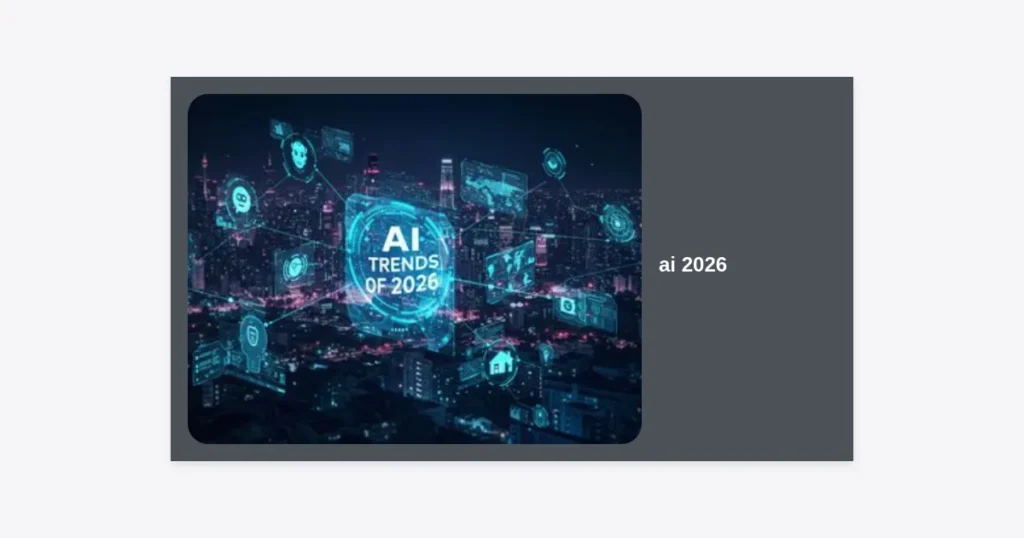

The rapid acceleration of machine learning has brought us to a pivotal moment in human history. As we look toward the landscape of AI 2026, we are no longer talking about simple chatbots or image generators. We are entering an era of autonomous agents, integrated robotics, and unprecedented economic shifts. By 2026, the distinction between digital or human-led workflows will blur, necessitating a proactive approach for businesses and individuals alike to stay relevant in this fast-evolving ecosystem.
- The Evolution: From Generative to Agentic AI 2026
- Industry Shakedowns: Healthcare, Finance, and Education
- The Foundation: Hardware, Energy, and the GPU Race
- Employment in 2026: New Roles and Necessary Skills
- The Ethical Horizon: Regulation and Privacy
- Actionable Strategies: Preparing for the 2026 Landscape
- Conclusion: Embracing the Intelligence Revolution
The Evolution: From Generative to Agentic AI 2026
By the time we reach the mid-point of the decade, the novelty of “generating text” will have faded into the background. The core focus of AI 2026 will be agency. Unlike current models that require constant prompting, the next generation of systems will operate as autonomous agents capable of multi-step reasoning and independent execution.
These agents will not just write an email; they will manage your entire project schedule, negotiate with vendors, and optimize your business’s supply chain without human intervention for routine tasks. This shift from reactive tools to proactive partners is the hallmark of the 2026 technological paradigm.
The Rise of Multimodality
In 2026, models will be natively multimodal. This means they won’t just “combine” text and images through separate layers; they will perceive the world through a unified sensory framework. Video generation will be indistinguishable from reality, and AI will be able to “watch” a live stream of a physical process to provide real-time optimization advice.
“The successful integration of AI agents into the workforce by 2026 will lead to a 40% increase in labor productivity across developed economies.” – Hypothetical Economic Growth Report
Industry Shakedowns: Healthcare, Finance, and Education
No sector is immune to the waves of AI 2026. However, three specific industries are poised for a total structural overhaul. Understanding these shifts is vital for anyone operating within these high-stakes environments.
Transforming Healthcare
By 2026, personalized medicine will be the standard. AI models will analyze an individual’s entire genetic code, lifestyle data from wearables, and real-time biometric feeds to predict illnesses before symptoms even appear. Surgery will be increasingly assisted by AI-driven robotics that can compensate for human micro-tremors with sub-millimeter precision.
- Predictive Diagnostics: Early detection of oncology-related issues at a 99% accuracy rate.
- Drug Discovery: Reducing the time to find viable clinical compounds from years to months.
- Virtual Health Assistants: 24/7 AI nurses that handle triage and prescription management.
The Financial Revolution
Financial markets in 2026 will be defined by algorithmic speed that exceeds human comprehension. Quantitative trading will evolve into “Adaptive Learning Finance,” where models rewrite their own logic based on black-swan events in real-time. For the average consumer, hyper-personalized financial planning will become an automated utility, optimizing taxes and investments daily.
The Foundation: Hardware, Energy, and the GPU Race
The success of AI 2026 relies heavily on the physical infrastructure supporting it. The industry is currently witnessing a massive build-out of data centers. We are moving toward a future where “Compute” is the world’s most valuable commodity, potentially surpassing oil in geopolitical importance.
Energy consumption remains the biggest hurdle. By 2026, we expect to see the first wave of specialized AI chips that operate on neuromorphic principles, consuming less than 10% of the power required by today’s standard GPUs. Companies that invest in sustainable energy sources, such as modular nuclear reactors, to power their data centers will be the leaders of the pack.
Employment in 2026: New Roles and Necessary Skills
A major pain point for many today is the fear of job displacement. While it is true that many manual and cognitive routine tasks will be automated, AI 2026 will create entirely new categories of employment that we are only beginning to imagine today.
Roles of the Future
- AI Orchestrators: Professionals who manage fleets of autonomous AI agents to achieve complex business goals.
- Algorithmic Auditors: Experts tasked with ensuring that AI systems are making unbiased and ethical decisions.
- Human-Machine Teaming Coaches: Psychologists and trainers who help humans adapt to working alongside high-intelligence digital entities.
The most valuable skill in 2026 will not be coding (which AI will largely handle) or data entry. It will be Strategic Problem Formulation: the ability to ask the right questions and design the high-level logic that AI systems will then execute.
The Ethical Horizon: Regulation and Privacy
As we approach 2026, the “Wild West” era of AI development is coming to a close. Global governments are already drafting stringent regulations. The focus will be on Transparency and Accountability. If an AI system makes a mistake—whether it’s a medical misdiagnosis or a financial error—there must be a clear legal framework to determine liability.
Data privacy will also undergo a revolution. The concept of “Personal AI Sovereignty” will emerge, where individuals own their personal data models and lease access to companies rather than giving it away for free in exchange for services. AI 2026 will be the year where privacy-preserving techniques like Federated Learning become mainstream.
Actionable Strategies: Preparing for the 2026 Landscape
To benefit from the AI 2026 transition, you cannot afford to wait. The following steps are practical ways to ensure you and your organization are ahead of the curve:
For Businesses
Audit Your Data Infrastructure: AI is only as good as the data it consumes. Ensure your data is clean, centralized, and ethically sourced. If your data is silos, your AI implementation will fail.
Pilot Agentic Workflows: Stop thinking about AI as a search engine. Start experimenting with tools that can perform actions (e.g., agents that can book travel, update CRMs, or generate code based on natural language requirements).
For Individuals
Develop “AI Literacy”: You don’t need to be a data scientist, but you do need to understand how large models think, their limitations (hallucinations), and how to verify their output. Treat AI as a highly competent but sometimes overconfident intern.
Focus on Soft Skills: Empathy, ethical judgment, and complex negotiation are currently the hardest things for machines to replicate. Double down on your “human-centric” capabilities.
Conclusion: Embracing the Intelligence Revolution
The road to AI 2026 is filled with both immense opportunity and significant challenges. We are standing on the brink of a new Renaissance where the limits of human achievement are expanded by the power of silicon-based intelligence. The key takeaways for the next two years are simple: stay curious, prioritize ethics, and move from being a consumer of AI to an architect of its output.
Whether you are a developer, a CEO, or a student, the actions you take today will determine your position in the world of 2026. This is not just a technological shift; it is a fundamental change in how we live, work, and relate to the world around us. Let us build a future where AI serves humanity’s highest potential.